6 tips to lower fuel consumption and CO2 emissions
By Stoyan Stoyanov · 6 years ago

Driving Economically and with respect for the environment is what the future is all about. Various factors determine the fuel consumption, the burden on the environment and the wear on the engine, brakes and tyres. The personal style of driving determines to a great extent the economic aspect and the exhaust and noise development.
Here are 6 tips to lower your fuel consumption, bad emissions and the tyres and brakes
wear and tear:
1. Do not warm up the engine or use the AC with the vehicle stationary.
At idling speed it takes a very long time until the engine becomes operationally warm. However, in the warm-up phase, wear and the discharge of pollutants is particularly high. For this reason, drive off immediately after starting the engine and avoid high engine speeds.
- 2. Avoid full-throttle acceleration.
Not only is the fuel consumption reduced considerably if one accelerates with feeling, but the disturbance to the environment and the wear are also reduced.
3. Do not drive with unnecessarily high
engine revs – change up as soon as possible, only change down when the engine
no longer runs smoothly.
The fuel consumption is, for example, more than twice as high in 2nd gear than it is in top gear. At the same time, the reduced engine speed means a reduction in engine noise. Automatic cars are made to do just that, and if your car is automatic, you shouldn't worry about it.
4. Try not to drive at maximum speed.
The fuel consumption, CO2 emissions and noise increase disproportionately at high speeds. If you use approximately only 3 quarters of top speed, the fuel consumption will be reduced about half. Experience has shown that the loss in time is only marginal.
5. Drive as smoothly as possible and look well ahead.
Unnecessary acceleration and braking is usually paid for with higher fuel consumption and more disturbance to the environment. That’s a note for bus and taxi drivers too and not just for the novice drivers, as many passengers have complained about the unnecessary “gas-break-gas” driving.
6.
Switch the engine off during traffic hold-ups.
Some new vehicles already have incorporated the stop-engine feature on traffic lights or when stuck in traffic. You could do that manually if your car doesn’t have such a feature.
Related Posts
When your Malta road licence is due (by the first letter of your number plate), how to renew online or through your insurance agent, what you need, and the €10-a-month fine for renewing late.
8 days ago
Selling or buying a used car in Malta? What Transport Malta needs for a change of ownership: the signed logbook, insurance, the €10 fee, and what changes for lost logbooks, company cars, inheritance and personalised plates.
8 days ago
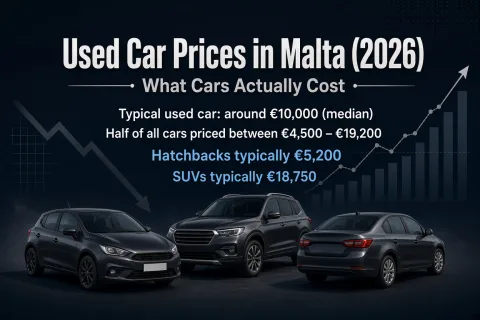
What used cars really cost in Malta in 2026, based on 129 cars listed on CarsMT: typical prices by age, make, body type and gearbox, and what each budget buys.
9 days ago
Find out how much car battery replacement costs in Malta, including battery prices, fitting, Start-Stop batteries, roadside assistance and local suppliers.
1 month ago